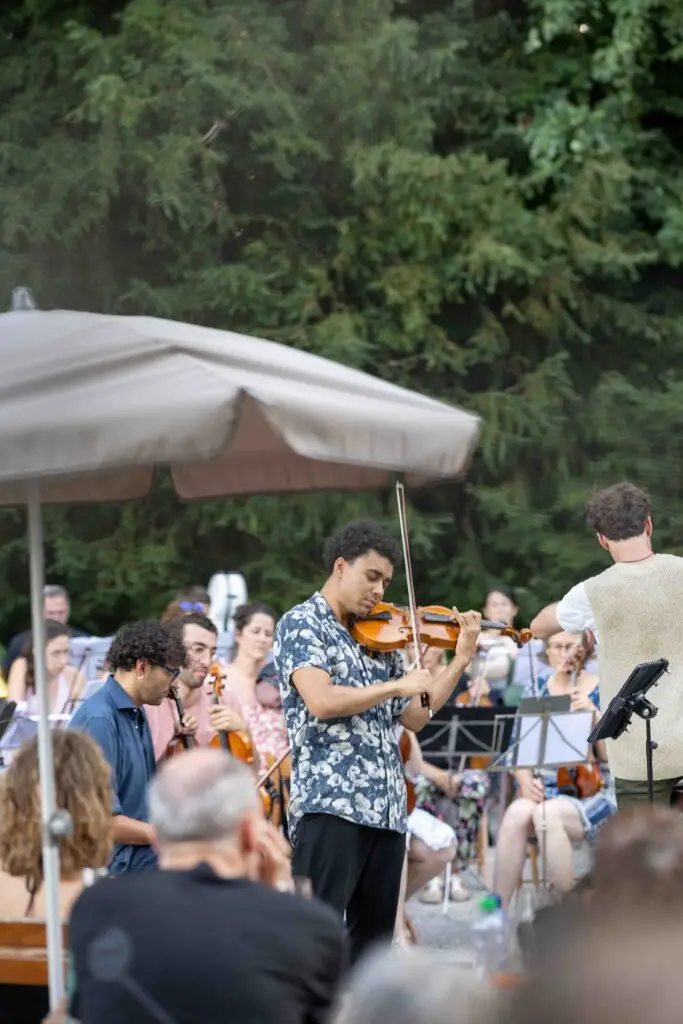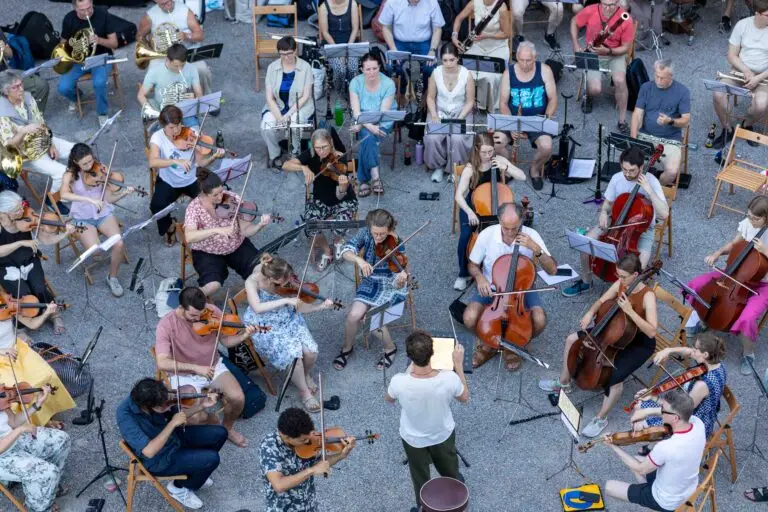

Your city. Your orchestra. Your choice. For its second edition, Simple Symphony’s format moved into the heart of Lucerne’s old town – with 65 musicians of the Lucerne Festival Contemporary Orchestra and more than 1,600 listeners over two evenings.
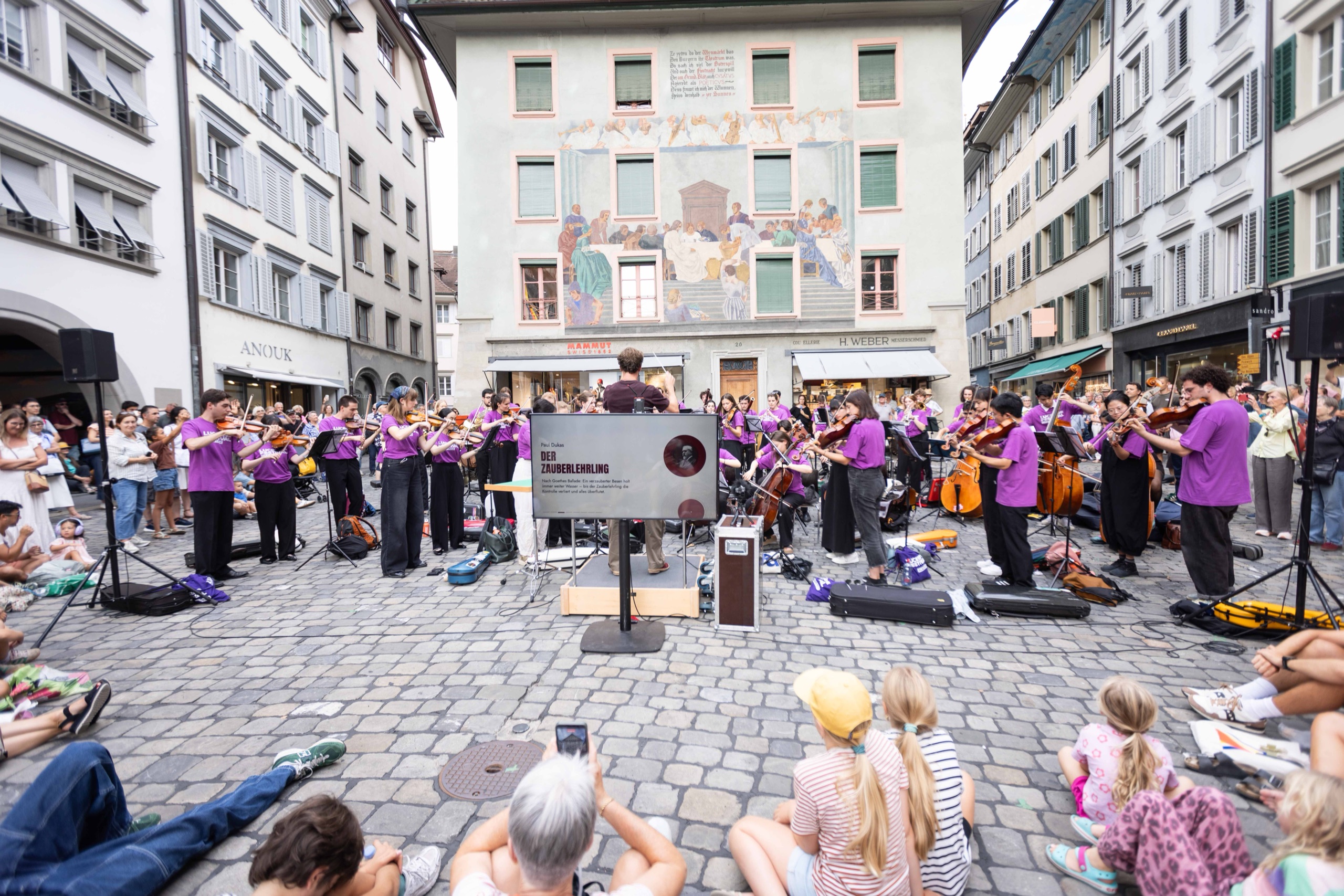
On an August evening, the Weinmarkt in Lucerne is full. Families, teenagers, tourists and seasoned festival-goers stand shoulder to shoulder or sit on the cobblestones. In front of them is no stage and no programme booklet, only a symphony orchestra, standing, and a touchscreen. Whoever steps up to it decides what happens next.
That is the idea behind the Symphonic Jukebox, a format created by Simple Symphony and its artistic director, the conductor Joseph Sieber. A year after its premiere, it returned to Lucerne Festival on 26 and 27 August 2026 – no longer as an experiment, but as a fixed point of the festival’s newly conceived street programme, “In the Streets: City Stage”.
From pilot to programme
The Jukebox was first tried out in summer 2025 with musicians of the Lucerne Festival Academy, at the festival’s 40min Open Air on Europaplatz and again in September on Kapellplatz and Hirschenplatz. The response was enough for Lucerne Festival to bring it back – with new features, a new design and additional works drawn from the festival’s main programme.
The timing was right. Under its new Executive and Artistic Director, Sebastian Nordmann, Lucerne Festival has reinvented “In the Streets”, its street-music festival since 2005, and tied it more closely to the main programme. For six days, the Lucerne Festival Contemporary Orchestra (LFCO) left the KKL Luzern for the squares of the old town. “Through formats such as pop-up concerts or our ‘Jukebox’,” Nordmann said when announcing the series, “we engage directly with the audience and create new, accessible ways into classical music.”
33 possibilities
There were four performances, two each evening at 18:00 and 19:15 – on the Weinmarkt on Wednesday, on the Kapellplatz on Thursday, admission free. The catalogue held 33 excerpts in Simple Symphony’s own edition, from Vivaldi and Beethoven to Smetana’s Vltava and Dukas’s The Sorcerer’s Apprentice. In keeping with this year’s festival theme, “American Dreams”, it also included Gershwin, Bernstein and John Adams.
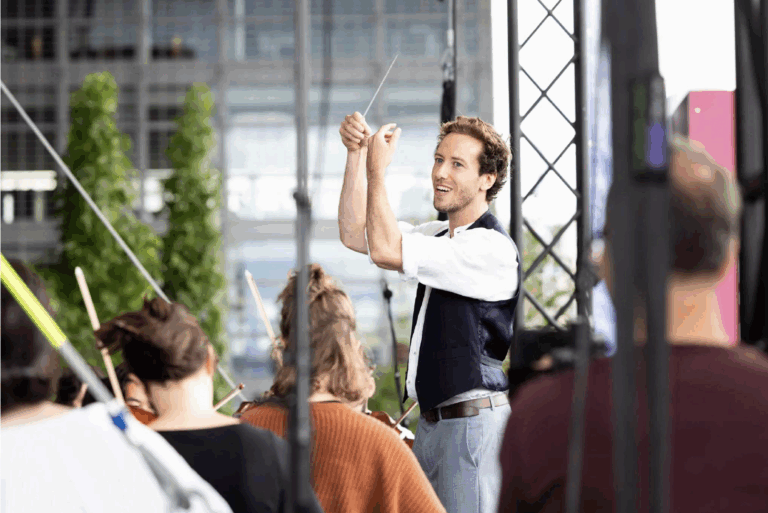
The principle fits into three words: choose, play, experience. The orchestra performs the most representative passage of each chosen work, a few minutes long, and then the next choice is made. While the musicians turn to the new score, Joseph Sieber – conductor and host in one – fills the changeover with stories about composers and works, questions from the audience and voices from within the orchestra.
The LFCO usually devotes itself to the music of our time. On these two evenings it revelled in melody and rhythm. Sieber called the 65 musicians “an incredibly good group” – they had two rehearsals for 33 works.
Request-concert democracy
What the audience chose said a great deal. Beethoven won, the Luzerner Zeitung reported, “but Mahler, Shostakovich and Khachaturian’s ‘Sabre Dance’ also got a taste”. The Schweizer Musikzeitung heard the waltz from Shostakovich’s Jazz Suite alongside Adams’s rhythmically intricate Short Ride in a Fast Machine. It also watched Sieber hand the baton to a volunteer for an excerpt from “Jupiter” in Holst’s The Planets. SRF’s Regionaljournal Zentralschweiz described a little girl dancing in front of the orchestra and an elderly couple taking to the floor for the waltz.
The city joined in, too. A municipal vehicle sounded its horn at the densely packed crowd – its pitch, the Luzerner Zeitung noted, fitted the orchestra tolerably well. Whoever declares the city a stage, the paper concluded, gets the whole city.
A meeting of generations
More than 1,600 people heard the Symphonic Jukebox over the two evenings. “Families, older festival-goers, teenagers, tourists,” wrote the Luzerner Zeitung: “the late-summer evening becomes a meeting of generations.” The paper called the Jukebox “a popular highlight” of the street programme.
That is precisely the point. Simple Symphony was founded in Lucerne in 2024 to bring classical music to where people are today, regardless of age or prior knowledge. For Joseph Sieber, a former Conducting Fellow of the Lucerne Festival Academy, the return to the festival also carries a quiet sense of homecoming.
Made to travel
The Symphonic Jukebox needs no stage and no concert hall – only a public square, an orchestra and a curious audience. Its excerpts of one to four minutes are arranged for a flexible orchestration and can be tailored to an orchestra’s own season highlights. The format is available to festivals, orchestras and cities.